
Traditional vs Infrared: Which Sauna Suits You
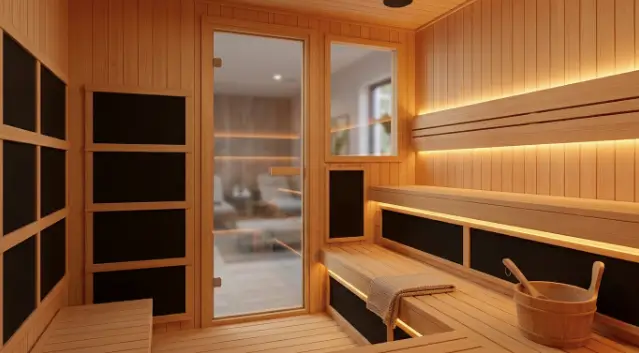
A traditional sauna heats the air to 150 to 195 degrees Fahrenheit with an electric or wood-fired heater and offers steam by pouring water on hot stones. An infrared cabin warms the body directly with carbon or ceramic panels at a gentler 120 to 150 degrees, heats up in 10 to 15 minutes, and usually plugs into a standard 120-volt outlet. Neither is objectively better; the right choice depends on the intensity you want, your electrical setup, and how much space and budget you have available.
How Does the Heating Method Actually Differ?
A traditional sauna’s electric or wood-fired heater warms the surrounding air, and that hot air in turn warms the body, which is why the room needs to reach a high ambient temperature, typically 150 to 195 degrees, before a session feels effective. An infrared cabin skips heating the air as an intermediate step; carbon or ceramic panels emit infrared radiation that warms the body’s tissue directly, so the cabin’s ambient air temperature stays much lower, generally 120 to 150 degrees, while still producing a real sweat response. This is the single biggest functional difference between the two and drives most of the other tradeoffs below.
Which One Costs Less to Buy and Install?
Infrared cabins generally win on total installed cost. A one or two-person infrared unit typically runs $1,800 to $3,800 and, on an existing 120-volt outlet, needs no electrical work at all. A comparable traditional sauna needs a heater, which alone can run $1,000 to $2,500, plus the cabin itself, and heaters above roughly 6 kilowatts usually require a dedicated 240-volt circuit, adding $300 to $900 or more in electrician cost. Larger traditional builds with a bigger heater and more wood surface area push total cost meaningfully higher than an equivalent-size infrared cabin.
Which One Delivers the Session You Actually Want?
This comes down to personal preference more than any objective ranking. A traditional sauna’s higher heat and optional steam produce a sharper, more intense sensation that longtime sauna users often specifically seek out, and the option to control humidity by adding water to the stones gives a traditional session more variability from one sitting to the next. An infrared cabin produces a gentler, more sustained warmth that many people find easier to tolerate for a full 30 to 40 minute session, particularly people who find a traditional sauna’s peak heat uncomfortable. Neither sensation is more legitimate than the other; they are genuinely different experiences aimed at different preferences.
Which One Fits Better Into an Existing Home?
Space and electrical capacity often decide this question before preference even comes into play. A one-person infrared cabin needs roughly 3 by 3 feet of floor space, 6.5 feet of ceiling height, and a standard outlet, which makes it realistic for a bedroom corner, garage nook, or finished basement with no renovation. A traditional sauna, particularly an outdoor barrel or cabin model, generally needs a dedicated pad or foundation, a higher-capacity electrical circuit, and more total footprint once the heater and stone guard clearances are factored in. Renters and buyers without spare electrical capacity in their panel tend to gravitate toward infrared for exactly this reason.
How Fast Does Each One Get You to a Usable Session?
Infrared cabins typically reach a usable temperature in 10 to 15 minutes, since the panels only need to warm up rather than heat an entire room of air. A traditional sauna with an electric heater generally takes 30 to 45 minutes to reach full operating temperature, and a wood-fired heater can take even longer depending on the wood and how well the cabin is sealed. For someone who wants a spontaneous 20-minute session after work with minimal wait time, this difference matters more than it might seem on paper.
How Does Climate Factor Into the Decision?
Climate changes the calculation more than most first-time buyers expect. An outdoor traditional barrel or cabin sauna in a cold, wet, or coastal climate needs to hold up to freeze-thaw cycles, rain runoff, and UV exposure on its exterior wood, which is why established makers use weather-rated cedar and design in a sloped roof and raised base specifically for outdoor durability. An indoor infrared cabin sidesteps most of that entirely, since it typically lives inside a conditioned room and never faces the elements, which is one reason it tends to need less exterior maintenance over its lifespan than an outdoor traditional unit in a harsh climate.
In a hot, dry climate, the tradeoff shifts somewhat. An outdoor traditional sauna’s higher heat output can feel excessive layered on top of an already warm summer, while an infrared cabin’s lower operating temperature and shorter warm-up time make it easier to use comfortably even during warmer months. Buyers in a climate with real winters and real summers sometimes end up choosing based on which season they expect to use the sauna most, since a cabin that only gets used four months a year has a very different cost-per-session calculation than one used consistently year-round.
What Does the Research Say, and Does It Favor One Type Over the Other?
The research most often cited in sauna marketing studies traditional, higher-heat Finnish sauna bathing rather than infrared specifically. A 2018 review in Mayo Clinic Proceedings summarized cardiovascular associations tied to regular sauna bathing. A systematic review in Evidence-Based Complementary and Alternative Medicine reached similar conclusions about regular dry sauna use more broadly. An older review in The American Journal of Medicine covers both benefits and known contraindications of sauna bathing generally, useful context for either type. None of these studies directly compare traditional and infrared outcomes, so the honest answer is that the strongest population-level evidence currently favors traditional sauna data simply because that is what has been studied at scale, not because infrared is inherently less beneficial.
Both traditional and infrared models, sized and priced for direct comparison, are listed at https://sweatdecks.com alongside their electrical and space requirements.
Frequently Asked Questions
What is the main difference between a traditional and an infrared sauna? Traditional heats the air to 150-195 degrees using a heater and stones, with steam available. Infrared warms the body directly with panels at a lower 120-150 degree range, no steam.
Which is cheaper to install, traditional or infrared sauna? Infrared is typically cheaper since most cabins run on a standard 120-volt outlet. Traditional heaters above about 6 kilowatts usually need a dedicated 240-volt circuit.
Does an infrared sauna feel as intense as a traditional sauna? No. Infrared produces a gentler, longer-tolerated session at lower temperature, while traditional’s higher heat and steam feel more intense.
Which type of sauna heats up faster? Infrared cabins reach usable temperature in 10 to 15 minutes. Traditional electric-heater saunas typically take 30 to 45 minutes.
References
- Benefits and risks of sauna bathing, The American Journal of Medicine, 2001
- Cardiovascular and Other Health Benefits of Sauna Bathing: A Review of the Evidence, Mayo Clinic Proceedings, 2018
- Effects of heat and cold on health, with special reference to Finnish sauna bathing, American Journal of Physiology – Regulatory, Integrative and Comparative Physiology, 2018
By Mitchell Boyce